Situated in the eastern part of the state of Telangana, India, the district of Warangal district (historically known as Orugallu) occupies a unique place in the cultural, historic and developmental tapestry of the region. Underpinned by a glorious past, contemporary momentum and rich heritage, Warangal is at once a symbol of the legacy of the Kakatiya dynasty and a locus of future-oriented growth. This article explores Warangal in depth—its historic roots, current developmental trajectory, major tourist and cultural landmarks, the living culture of its people, and how these threads interweave to offer a story of continuity and change.
We begin by tracing the historical and geographic context of the district; then we look at its modern development and economy; follow up with key visitor attractions; then discuss the cultural matrix (festivals, crafts, cuisine, community life); and finally reflect on the challenges and prospects ahead.
Historical & Geographical Background
6
Location and geography
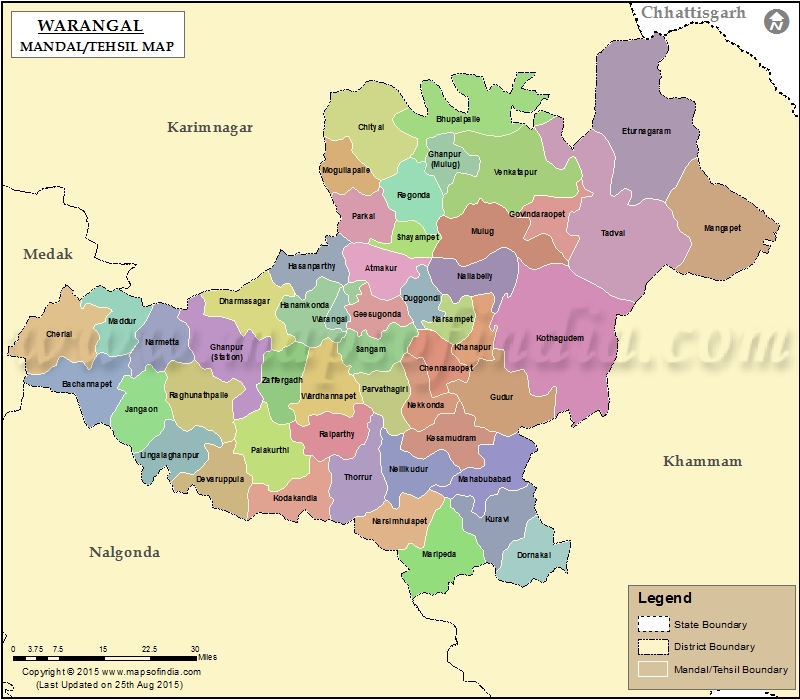
The Warangal district lies in the north-eastern portion of Telangana, approximately 150 km from the state capital, Hyderabad. Telangana Tourism+1 The terrain is a mix of undulating plains, rocky hillocks, lakes and water bodies, moderate vegetation and agricultural land. Historically it has been a nexus between the Deccan plateau and the eastern plains, which gave it strategic importance.
Origins of Orugallu / Warangal
The name “Orugallu” means “one rock” (in Telugu oru = one, gallu = stone) and reflects the region’s connection with rocky outcrops and fortifications. kakatiya.ac.in Under the Kakatiya dynasty (roughly 12th to 14th century CE), Warangal rose to prominence as a capital region and as a political, cultural and architectural centre of the Telugu-speaking region.
The Kakatiya dynasty and its legacy
The Kakatiyas unified large parts of the Telugu region and introduced administrative, architectural and cultural innovations. Their reign left behind a heritage of temples, fortifications, inscriptions and urban structure. As noted by the Archaeological Survey of India and state government websites, Warangal continues to be one of the best-preserved heritage cities in India. Incredible India+1
The heritage includes structures such as the fort at Warangal, the Thousand Pillar Temple, and later the celebrated Ramappa Temple (though slightly outside the strict municipal boundaries) which has been recognised by UNESCO as a World Heritage Site.
Administrative evolution
In modern times, the district has been through reorganisation. While the historic “Warangal” district was subdivided (for example into Hanamkonda, Warangal Urban, Warangal Rural, etc) over recent years, for the purpose of understanding the broader region it is still useful to consider the “Warangal region” as inclusive of Warangal-Hanamkonda and adjoining areas. According to the official district portal, the culture & heritage section lists Warangal as a heritage city state under this broader region.
Development & Economic Landscape
Industrial growth and job creation
One of the most striking features of Warangal’s recent trajectory is the industrial momentum. Under the TS‑iPASS (Telangana State Industrial Project Approval & Self-Certification System) mechanism, the district has attracted a significant number of industrial units. As one report from June 2023 notes: “a total of 1,825 major industrial units have been established in Warangal, attracting an investment of Rs. 5,960 crore.” Telangana Today These units have provided employment to thousands of people. The report mentions 18,366 people employed as of that time. Telangana Today
Another major nodal industrial project is the Kakatiya Mega Textile Park (KMTP) which is designed as a “cotton-to-garment” park (end-to-end textile value chain) over a large land parcel (1190 acres mentioned in one article) and expected to create about one lakh (100,000) jobs once fully operational. Telangana Today+1
These developments mark a transition from a primarily agrarian economy to a more diversified industrial base, which bodes well for employment, incomes and regional competitiveness.
Agriculture, handloom and traditional industries
While industrialisation is gaining pace, agriculture remains a backbone in Warangal district and the surrounding region. According to the district economy portal: grain production and allied activities are significant components. warangal.telangana.gov.in+1
In addition, the region has a strong handloom and textile heritage. The state’s tourism site notes that the weaving of cotton dhurries (floor rugs) using tapestry or ikkat technique was a culturally embedded craft here. Telangana Tourism
Hence, the region is both modernising and still retaining traditional sectors—offering a blended economic structure.
Urban infrastructure, connectivity and smart-city efforts
Urban development has also been on the agenda. The region of Warangal (including Hanamkonda / Warangal Urban) has been included in the national Smart Cities Mission (though with some implementation delays). According to news reports, as of August 2025 the city had completed about 66 % of its 119 projects worth ₹1,800 crore under the Smart City programme—still lagging behind expected targets. The Times of India
Connectivity improvements are underway. For example, the state government released ₹205 crore to fast-track land acquisition for reviving the historic Mamnoor Airport (to become the second commercial airport for Telangana) in the Warangal region. The Times of India
Such infrastructural and connectivity push indicates that Warangal is positioning itself for future urban and regional growth.
Challenges & socio-economic indicators
On the social front, the district has recorded a literacy rate of approximately 84.16 %, with male literacy about 91.54% and female literacy about 76.79%. warangal.telangana.gov.in While these are respectable figures, the gender gap persists and deeper structural issues (employment quality, youth skills, infrastructure bottlenecks) remain.
Further, as with many regions undergoing transition, issues such as land acquisition, institutional coordination, urban governance turnovers (nine municipal commissioners in ten years, according to one Reddit thread) create friction in execution. Reddit
In summation, Warangal’s economy today is at an intersection: reviving tradition (handloom, agriculture) and embracing industrial & urban modernisation.
Major Tourist & Visiting Spots in Warangal
One of Warangal’s great advantages is its rich heritage and natural beauty. For visitors and residents alike, the district offers a compelling mix of architecture, religion, nature, water bodies and landscape.
1. Warangal Fort
The centrepiece of Warangal’s historic identity. This fort was erected in the early 13th century by the Kakatiya kings (notably by Ganapati Deva) and further developed by Rani Rudrama Devi. hanumakonda.telangana.gov.in+1
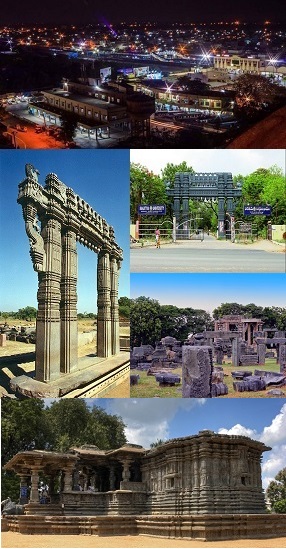
One of the most iconic features is the ornate stone arch known as the “Kakatiya Kala Thoranam” (the arch gateway), which has become a symbolic emblem of the region. The architecture reflects the Kakatiya style: granite stones, lofty gateways, defensive walls, and integration with natural hillocks. kakatiya.ac.in
As a tourist attraction, Warangal Fort offers insights into medieval fortification, temple-fort interplay (the Bhadrakali Temple is within the complex) and panoramic views of the surrounding city.
Thousand Pillar Temple (Hanamkonda)
Built in the 12th century by the Kakatiya king Rudra Deva, this temple is a beautiful representative of Kakatiya architecture. hanumakonda.telangana.gov.in
The temple is also known as Sri Rudreshwara Swamy Temple and features three sanctums dedicated to Lord Shiva, Lord Vishnu and the Sun God respectively (a trikuta structure). The finely carved pillars, rock-cut elephants, massive Nandi carved of a single stone, all make the temple architecturally special. hanumakonda.telangana.gov.in
It is located at the base of Hanamkonda hill, which adds to its setting and ambience. For visitors, it is a must-visit heritage landmark.
Ramappa Temple (Kondapalli, about 70 km from Warangal)
This temple, officially called Kakatiya Rudreshwara Temple, was inscribed as a UNESCO World Heritage Site in 2021. Its architectural features are astounding: the temple is built on a raised platform using “floating bricks” that minimise vibrations from the nearby river, and the pillars, carvings, red-sandstone decorative elements, and narrative sculptures of the Kakatiya era are exquisite.
Although technically slightly outside the immediate district urban area, its association with Warangal’s heritage makes it part of the “Warangal tourism circuit.” The inclusion of Ramappa in the UNESCO list has boosted the region’s visibility internationally.
Bhadrakali Temple & Bhadrakali Lake
The Bhadrakali Temple is perched atop a hillock between Warangal and Kazipet. The goddess Bhadrakali’s eight-armed idol within the temple complex is noteworthy. The adjacent Bhadrakali Lake, built by the Kakatiya king Ganapati Deva, has been developed into a geo-biodiversity cultural park with promenades, natural trails and ecological reserves. Wikipedia
Together, the temple and lake offer a combination of spiritual ambience, scenic nature and relaxing outdoor time for visitors and families.
Pakhal Lake
Constructed in the 13th century by the Kakatiya ruler Ganapati Deva, Pakhal Lake is a man-made reservoir nestled amidst forest hills and valleys. According to the tourism site, it is about 50 km from Warangal and popular for boating, bird-watching and nature retreats. sakaholidays.com
For those seeking a break from the heritage monuments and city bustle, Pakhal offers a refreshing nature-based outing.
Kakatiya Rock Garden
Situated near Bhadrakali Temple and Lake, the Rock Garden is a unique landscaped area where artistic sculptures made of rock, clay and metal combine with natural terrain, offering a more contemporary attraction within the Warangal tourism scene.
Other notable spots
Beyond the major sites listed above, visitors to Warangal might explore:
- Padmakshi Temple (12th century, Hanamkonda) with historical Jain and Hindu associations. hanumakonda.telangana.gov.in
- Laknavaram Lake (boating, forest & water views) cited among the top-12 attractions in Warangal. sakaholidays.com
- The city’s musical garden, planetarium, zoo (e.g., Kakatiya Zoological Park) etc., offering leisure and family options.
Summary of visitor appeal
The combined attraction of Warangal is that it delivers:
- Deep historical architecture (forts, temples) with Kakatiya roots
- Sacred/temple sites for pilgrimage and cultural interest
- Natural beauty (lakes, forest, hills) for recreation and nature-lovers
- Urban heritage zones juxtaposed with newer developments
Visitors can easily plan 2-3 day circuits: historical-heritage in Hanamkonda/Warangal city, nature excursion (Pakhal, Laknavaram) and temple pilgrimage (Bhadrakali, Ramappa).
Culture, Crafts & Community Life
Language, demographics and lifestyle
In Warangal, the primary languages spoken are Telugu and Urdu, with knowledge of Hindi and English present among educated sections. warangal.telangana.gov.in
Ethnographically, the region comprises both Hindu and Muslim populations, living in largely peaceful coexistence, celebrating each other’s festivals and sharing civic space. warangal.telangana.gov.in
In terms of attire and lifestyle, rural women mostly wear sarees, while men traditionally wear a white lungi and shirt; however, modern Western attire (jeans, shirts, T-shirts) is increasingly seen especially among youth in urban zones.
Festivals and ritual life
Warangal’s cultural calendar is rich and vibrant. Some of the special festivals include:
- Bathukamma: A unique floral festival of Telangana, celebrated during Navaratri when women gather, sing folk songs and offer flower stacks (the Bathukammas) to the goddess. Warangal’s heritage sites (like Thousand Pillar Temple) often serve as the epicentre of celebrations. Incredible India+1
- Sammakka‑Sarakka Jatara: One of the largest tribal festivals in the region, celebrated in the forests of the district with thousands of devotees. Facts.net
- Traditional Hindu festivals such as Ugadi, Sankranti, Dussehra, Ganesh Chaturthi, Diwali; and Islamic festivals like Eid-ul-Fitr, Eid al-Adha, Milad un Nabi, Muharram are widely celebrated, reflecting communal harmony. warangal.telangana.gov.in
These festivals serve as powerful markers of identity, continuity and social cohesion.
Crafts, handloom and local industry
Warangal has a long tradition of handloom weaving and crafts—especially the weaving of cotton dhurries (floor rugs) in tapestry technique, block-printed rugs, ikkat designs and so on. Telangana Tourism
These crafts are not just economic activity but are expressions of local artistry, design sensibility and intergenerational skill-transmission. The state’s tourism website notes that the abundant availability of cotton in the region historically facilitated the growth of these weaving traditions.
Cuisine and local flavours
While the region shares many staples with Telangana broadly, there are some local flavour-twists: jonna rotte (sorghum roti), sarvapindi (rice-flour snack), kakarakaya curry (bitter gourd curry) are among regional items noted in a “32 facts” list about Warangal. Facts.net
Moreover, given the city’s proximity to Hyderabad and its role in the broader Telangana region, Hyderabadi-style biryani, haleem, lamb korma and other rich dishes find favour here.
Cultural significance and identity
Warangal is often referred to as the “cultural capital” of Telangana—because it encapsulates both the medieval imperial-era grandeur of the Kakatiyas and the living folk traditions of the Telugu region. Incredible India
Its architecture, festivals, crafts and public memory combine to offer a sense of identity and place. For example the Kakatiya arch (Kala Thoranam) has been adopted as one of Telangana’s official symbols, reaffirming Warangal’s place in the state’s narrative
The Intersection of Heritage & Modernity: Warangal’s Changing Face
Warangal is not frozen in time—it is evolving. What is particularly interesting is how heritage conservation, tourism promotion, industrialisation and urbanisation all intersect in the district.
Heritage tourism as economic lever
With heritage assets such as Warangal Fort, Thousand Pillar Temple, Ramappa Temple (UNESCO), the district has a built-in tourism potential. The government’s tourism portal highlights these attractions and encourages circuits that combine history, nature, spirituality and culture. Telangana Tourism
This heritage tourism offers local employment (guides, hospitality, crafts), appreciation for local culture and a route to invest in preservation. At the same time, it necessitates sensitive management (infrastructure, carrying capacity, conservation vs commercialisation).
Urban growth & smart city challenge
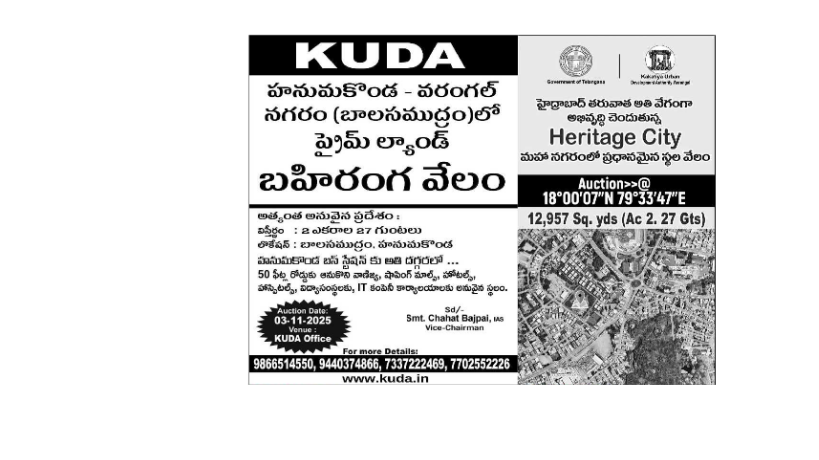
Warangal’s urban area (including Hanamkonda) is undergoing transformation: improved roads, ring-roads, enhanced civic infrastructure are in a planning and implementation phase. The master plan “KUDA Master Plan 2041” (for the Kakatiya urban development authority region) aims to guide growth for the next two decades. Reddit+1
Nevertheless, real-world implementation is always a challenge. As noted earlier, the Smart Cities Mission progress shows significant pending work and institutional hiccups.
Balancing traditional economy with modern industry
While handloom, agriculture and rural crafts remain important, the industrial push (textile park, manufacturing units) creates larger scale employment, modern infrastructure, value-chain linkages and urban-industrial spillovers.
Warangal’s challenge is to ensure that these modern industries integrate well with local communities, offer equitable employment, mitigate environmental/urban disruption, and align with the region’s heritage sensibilities.
Connectivity catch-up
With the thrust to revive Mamnoor Airport, improve rail links, highways, bus connectivity, Warangal is increasingly able to plug into regional, national and even international travel flows. Once the airport becomes operational, the tourism and industrial connectivity will be significantly boosted. The Times of India
Good connectivity also helps the crafts and handloom sector, enabling markets, exports and supply-chain integration.
Challenges ahead
Some of the key challenges include:
- Ensuring infrastructure keeps pace with growth (water, drainage, waste management, roads).
- Conservation of heritage sites while accommodating tourism and urban expansion.
- Ensuring equitable job creation (so that rural, tribal and marginalised communities benefit).
- Managing environmental sustainability (lakes, forested areas, wildlife sanctuaries) while allowing development.
- Strengthening governance, institutional continuity and capacity-building in municipal bodies and local agencies.
Significance & Importance of Warangal — Why It Matters
Warangal is not simply another district. Its importance spans multiple dimensions:
- Cultural and historical significance: As the erstwhile seat of the Kakatiya dynasty, Warangal preserves monumental legacies of medieval South India. The architectural, epigraphic and urban forms here are important for scholars, tourists and regional identity alike.
- Heritage-tourism potential: The deep heritage and natural beauty combine to make Warangal a significant tourist destination in Telangana and South India. The recognition of Ramappa Temple by UNESCO enhances the global visibility of the region.
- Regional economic engine: With the industrial units, textile park, connectivity enhancements and urban development, Warangal is becoming a regional economic growth node, potentially alleviating pressure from Hyderabad and providing balanced regional development.
- Cultural crossroads: The co-existence of Hindu and Muslim traditions, traditional crafts and modern lifestyles, festivals that change with seasons, all make Warangal a vibrant cultural ecosystem. It helps in preserving Telugu and Telangana identity in a fast-changing India.
- Model of balanced development: Warangal is illustrative of how a heritage city can evolve, rather than stagnate—combining preservation with innovation, rural and urban with crafts and industry, nature and architecture.
Development Strategy & Vision for the Future
To sustain its momentum, Warangal’s strategic agenda can cover the following pillars:
- Heritage conservation & adaptive reuse: Strengthen preservation of monuments such as Warangal Fort and Thousand Pillar Temple, develop interpretive centres, heritage walks, lighting and signage, and integrate local craft markets around these sites to create tourist-economy linkages.
- Integrated tourism circuits: Develop multi-day visitor packages combining city heritage (Fort, temples), nature retreats (Pakhal Lake, Bhadrakali Lake), tribal/forest experiences (Sammakka Jatara region), adventure activities (rock garden, boating). Improve last-mile connectivity, signage, visitor amenities.
- Industrial diversification & skill development: Expand the textile park and related industries while building local skill-ecosystem: weaving, garment manufacturing, technical training. Link craft handicrafts with global marketplaces (e.g., online handloom, designers). Strengthen agriculture-industry linkages (cotton, millet, sorghum supplies to textile park).
- Urban infrastructure & sustainable mobility: Accelerate Smart City projects, implement sustainable urban planning (green open spaces, public transport, waste management, lake conservation). Revive Mamnoor airport, develop improved bus/rail connectivity, strengthen ring-road and internal mobility.
- Inclusive rural-urban growth: Encourage peri-urban and rural linkages: craft clusters in villages, agro-processing units, ecotourism in forest belts, tribal participation. Focus on women’s livelihoods (e.g., Bathukamma festival craft enterprises), weaver welfare schemes (reflected in recent subsidies). Telangana Today
- Environmental and heritage ecosystem protection: Lakes (Bhadrakali, Pakhal), forests and hillocks are an asset—strictly protect them from overdevelopment, ensure sustainable tourism practices, develop biodiversity zones, nature trails, eco-friendly visitor facilities.
Conclusion
In the story of modern India’s districts, Warangal stands out as one where the past and future meet. From the granite arches of the Kakatiya era to the hum of new factories, from tranquil lakes to planned urban expansions, it is a region of rich contrasts and potential.
Its heritage is not a museum piece, but a living framework—temples still worshipped at, festivals still observed, crafts still woven. At the same time, a new chapter of economic and urban development is unfolding: the industrial units, textile park, improved connectivity and tourism push all suggest that Warangal is more than just preserving its past—it is redefining its future.
For visitors, Warangal offers more than just monuments: it invites immersion in history, culture, nature and living society. For policy-makers and development planners, it offers a template of how a heritage city can reinvent itself while retaining its roots.
Looking ahead, the success of Warangal will depend on how well the region manages to balance growth with preservation, inclusivity with modernisation, and local identity with global connectivity.
Whether one comes for the majestic fort, the spiritual calm of Bhadrakali Temple, the lush serenity of Pakhal Lake, or the vibrant celebrations of Bathukamma, Warangal promises a rich experience. In that sense, it deserves not only a place on the tourist map—but a place in the story of Telangana’s and India’s evolving narrative.
